


 Dec 29, 2025
 3 min read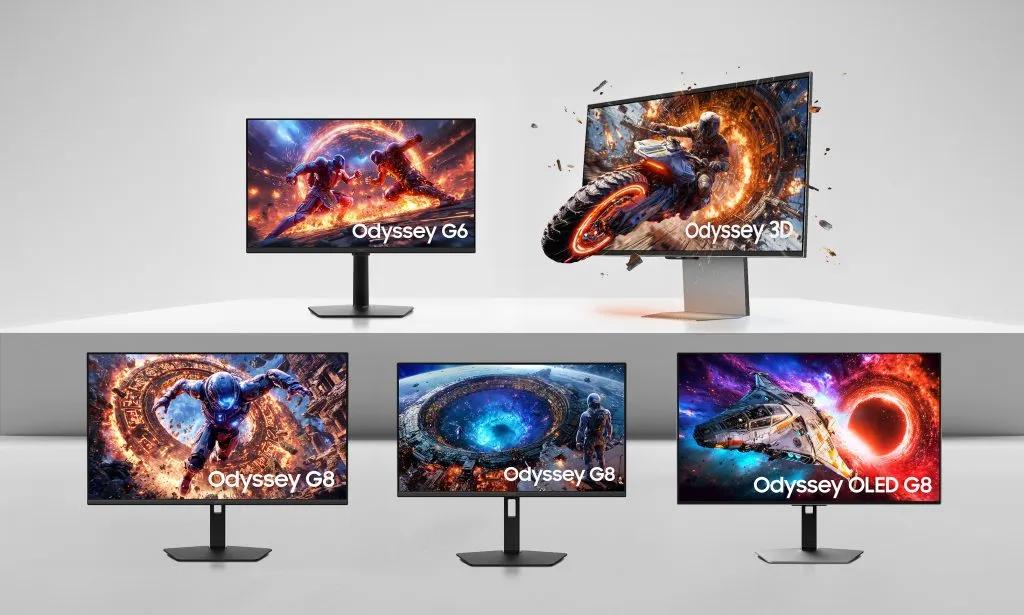
Samsung introduces the Odyssey 2026 series of glasses-free 3D monitors, 6K resolution and up to 1040 Hz, a possible premium alternative to VR.
Samsung has put an idea on the table that, if done right, could move important parts in the gaming and sim rating table: glasses-free 3D monitors, extreme resolutions (6K) and refresh rates up to 1,040 Hz in Dual mode.The announcement of the new Odyssey 2026 range, which will be presented at CES 2026 (January 6-9 in Las Vegas), is not just a feature: it's an attempt to change how we perceive depth and speed on the screen.
Samsung's new Odyssey range
Headlining for "Immersion" is the 32" Odyssey 3D (G90XH): 6K panel (6,144 x 3,456) offers glasses-free 3D, relying on real-time eye tracking to adjust perspective based on the viewer's position. as a feature.
Alongside that, for those who prefer the competition, there's the 27-inch Odyssey G6 (G60H), which is up to 1040 Hz (only in HD via dual mode) and up to 600 Hz at native QHD, with FreeSync support and G-Sync compatibility.
3D glasses-free vs. VR
In the SIM in SIM, the depths are not recognized: relative to the distance reading, the curvature, a enox, and the meaning of speed.That's why the VR is very beautiful: it gives a true stereoscopy and "the face."The problem is, not all the visor, and the virtual pilots would like to keep the peripheral information of their cooks.
Here, glasses-free 3D can open up an in-between space: deeper information than 2D without separating you from the environment like an HMD.Additionally, for content creators and streamers, a 3D viewer can do more (camera, annotation, overlay) than a full VR session.
The historical Achilles heel of 3D on PC was not the hardware, but the software: stereoscopic vision, compatibility with graphics engines, and especially the management of 2D interfaces (HUDs, mirrors, telemetry applications).Samsung claims that it will work with studios to build a "curated" library of games with optimized 3D effects (and it cites specific examples, although it is still outside of simracing).
For simracing, this implies a practical question: do we see support "out of the box" or does it depend on intermediate layers?Having a 2D → 3D conversion helps speed up adoption, but in simulators with a complex cockpit and many UIs, a simple conversion can introduce artifacts (incorrect depth of cockpit elements, text, markers or apps).
And 1000 Hz?A real benefit, but not in the way people think
1040Hz data has implications, but tends to be more marginal than competing shooters in simulating benefits: limitations usually come from display, physics, external latency and timing stability.Still, people who race in ultra-fast mode eSports environments or are looking for maximum motion precision in fast sweeps and fine-tuning may be interested, as long as the computer can keep up with those numbers.
Can it cause a change in performance?
Yes, but with a nuance:
- As a "premium" alternative to VR, especially for users who want depth without a headset and who already invest in high-end rigs.
- As a catalyst to improve the simulators' stereoscopic pipeline (if Samsung pushes contracts and tools for developers).
- As a good product, if the price is high and the compatibility is restricted to a short list, because simracing lives in the ecosystem (modules, overlays, triples, ultrawide, telemetry software) and any friction kills adoption.
In short: Samsung without 3D glasses has the ability to be a "theme" in making it a desirable brand.In practice, what will be decided is not 6K, but wide and stable compatibility without HUD and penalty devices.
Official information from Samsung.
Odyssey 2026 scope summary table
|FEET |EXERCISE |THEY |SECTION |SECTION |SECTION |SECOND DROP |SECTION |SECTION |
|Odyssey 3D |G90XH |32in
|Odyssey G6 |G60H |27" | QHD (2.560 x 1.440) | IPS | 600 Hz | 1.040 Hz (HD de Modo Dual) | HDMI 2.1; DP 2.1 | FreeSync Premium Pro; Compatibil G-Sync; Redare HDR10+ |
|Odyssey G8 |G80HS |32" | 6K (6.144 x 3.456) | IPS | 165Hz | 330Hz (Modo Dual 3K) | HDMI 2.1; DP 2.1 | |
| Odyssey G8 | G80HF | 27" | 5K (5,120 x 2,880) | IPS | 180Hz | 360Hz (KHD de Modo Dual) | HDMI 2.1; DP 2.1 |
|Odisséia OLED G8 |G80SH |32" | 4K (3.840 x 2.160) | QD-OLED | 240Hz | 240Hz | HDMI 2.1; DP 2.1 (UHBR20); USB-C (98W) | Sem reflexosGaming |